
This began with a stealth game and a suspicion. The fog was extraordinary, the missions in fog felt unfairly hard, and it seemed worth checking whether the two facts were related. They were, in the opposite direction to the obvious one: the fog was doing nothing except blinding the person holding the controller.
Having found one system like that we went looking for others, and the count now stands at twenty-eight. Six of them change how a game is played. The rest are lighting presets with excellent audio attached.
What is published here
Full reviews of PC games, with a weather classification beside the score rather than folded into it. The reviews cover everything a review normally covers — design, writing, structure, options — and then examine the sky in the detail nobody else has time for.
Alongside them there are notes: a single question asked of several games at once, such as why almost nothing models temperature, or what happens to a system's usefulness when its cycle drops below fifteen minutes.
How the work is done
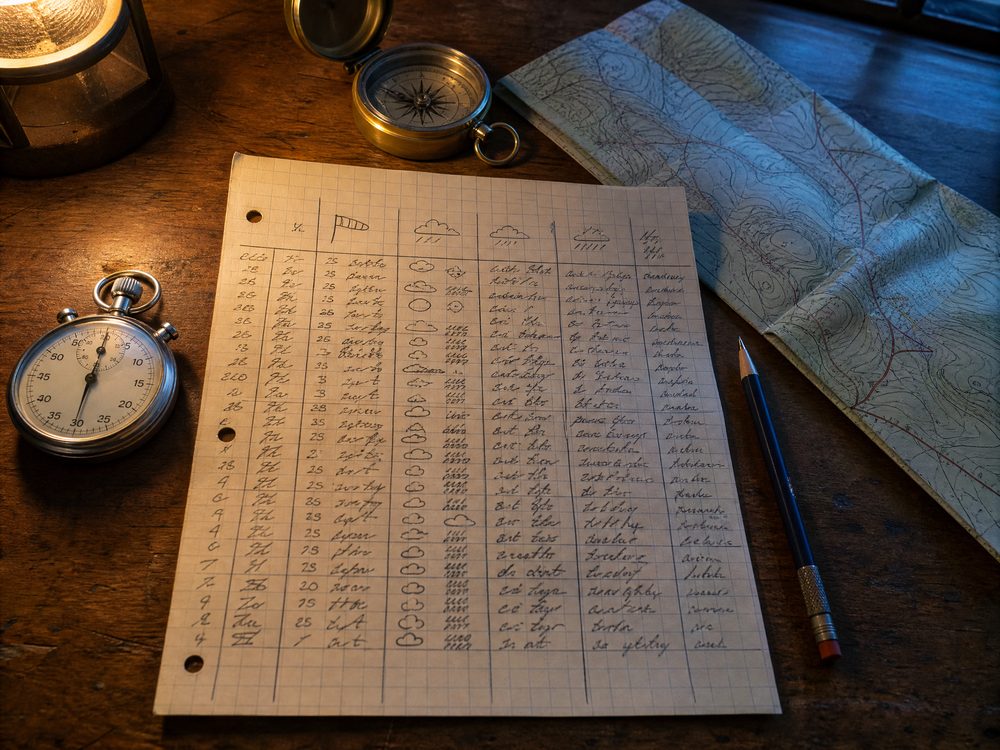
Slowly, and by hand. A full in-game year per game where a calendar exists, forty hours where none does, and every observation written in pencil on graph paper as it happens. No overlay, no memory inspection, no automated logging, because a tool that hooks into a game can tell you what a variable holds and not what a player experiences, and the gap between those two is exactly where the interesting failures live.
The consequence is that this site publishes five or six reviews a year. That is the price of the method and it is worth paying.
Every studio in the industry can tell you what their weather looks like. Very few can tell you what it does. The second question is the only one worth a publication.
What we will not do
No advertising, no sponsorship, no affiliate links, no storefront links. No review copies: every game logged here was bought at retail with the publication's own money, because a comparative judgement is worthless if anybody paid for where it landed. Nothing is published before the observation period is complete, whatever is being released that month.
We also do not score weather separately on a numeric scale, despite being asked to. A number invites a league table, and a league table would flatten the distinction between a system that is shallow and a system that is actively working against its player.
Why there is no contact page
Because nothing here can usefully be pitched — every article requires forty hours of play by the person writing it — and because a submission route on a small independent site mostly attracts people who would like to influence a classification.
Corrections still arrive, and they arrive better than a form would deliver them. Readers repeat these tests on their own installations, describe their method, and publish the result. Three amendments to the procedure have come that way, including the symmetry test in its current form, which a reader effectively designed for us.
What comes next
Temperature, which almost nothing models and which we suspect is the next interesting frontier. Weather in multiplayer games, where a shared sky raises questions of fairness that single-player systems never face. And a re-log of the earliest entries in the file, since three of them have been patched substantially since we published and the record should reflect it.
The short version
One tester, a stopwatch, a pencil, and twenty-eight skies examined for what they actually do. Everything else on this site is an application of a single question: does the weather change anything, and does it change it for everybody.