
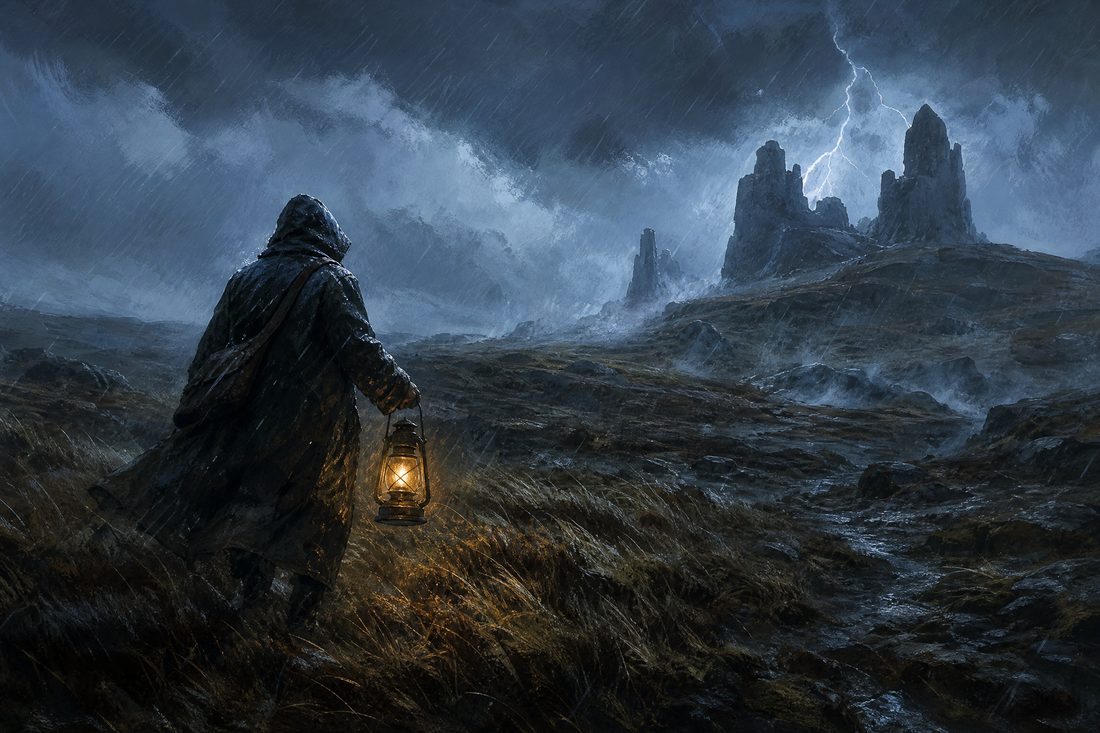
The premise is ordinary: you are alone on an upland moor with a shelter to maintain, a body to keep warm and fed, and a season to survive. What is not ordinary is that the water has somewhere to go.
Rain falls onto terrain that has a saturation value. Saturated ground drains downhill into hollows, hollows become standing water, standing water makes crossing slower and colder, and after a long dry spell the same hollows are the last places with anything to drink. Nothing about that is announced by the interface. You find it out by living on the hill.
What the system actually models
We spent about nine hours doing nothing but establishing this, since a system that appears deep in the first storm often turns out to be two variables and a particle effect. Here it is not.
| Property | Modelled | Notes |
|---|---|---|
| Ground saturation | Yes | Per-region, drains downhill over roughly a day |
| Clothing wetness | Yes | Dries by fire, by wind, or slowly on the body |
| Wind chill | Yes | Interacts with wetness rather than adding to it |
| Temperature | Yes | Diurnal and seasonal, with altitude effect |
| Visibility | Yes | Applies to animal detection as well as the camera |
| Humidity | Partially | Affects drying speed only |
The wet clothing decision
This is the piece of design the rest of the game hangs from. Getting soaked does not drain a meter; it changes a property of your clothing that then persists for hours. A wet coat in wind is worse than no coat in still air, and the fastest way to dry it is to take it off by a fire, which means being cold on purpose now to be warm later.
We recorded drying times because the whole economy of the game depends on them, and they are consistent to within a couple of minutes across conditions. That consistency is what allows a player to plan, and planning is what makes a survival game something other than a series of interruptions.
A meter that refills teaches you nothing. A property that persists teaches you to look at the sky before you leave the shelter, which is the only weather mechanic that has ever mattered.
Symmetry
The test this publication cares about most: does the weather apply to everything, or only to you. Here it applies to everything we could measure. Animals shelter in heavy rain and are genuinely harder to find. Their detection range drops in fog exactly as ours does — we established this by approaching the same herd in four conditions and recording the distance at which they moved.
Fire behaves correctly too: a fire in the open in rain needs more fuel and eventually fails, and a fire under an overhang does not. We could find no case where the weather was applied to the player and withheld from the world.
The twenty-two minute cycle
Long enough to be read, short enough that a session contains variety. Conditions do not snap: cloud builds, wind rises ahead of rain, and there is a recognisable ten-minute window in which an experienced player can decide to turn back. We timed forty transitions and the warning signs are always present and always the same.
That is the difference between forecasting and guessing, and it is why the cycle length is the second figure we record for any system.
Where the game is weaker
The crafting is unremarkable and there is too much of it; about a third of the recipes exist to consume time rather than to solve a problem. The narrative fragments scattered around the moor are thin and would have been better omitted. And the late game, once you have a fully weatherproofed shelter, loses most of its tension because the system you have mastered stops threatening you.
That last point is the strongest criticism available: the best weather simulation in games is also a difficulty curve that flattens the moment you beat it, and nothing else in the design steps in to replace it.
| Element | Assessment |
|---|---|
| Ground water model | Best in the file |
| Clothing and wind chill | Persistent, consistent, plannable |
| Symmetry with animals | Verified across four conditions |
| Crafting | Padded; a third is filler |
| Late game | Tension collapses after mastery |
Where this leaves it
The highest score this publication has given, and the reason is a single design principle applied without exception: weather changes properties of the world rather than values on a display. Everything admirable here follows from that, and so does the one real flaw, since a system this learnable eventually stops being an opponent.