
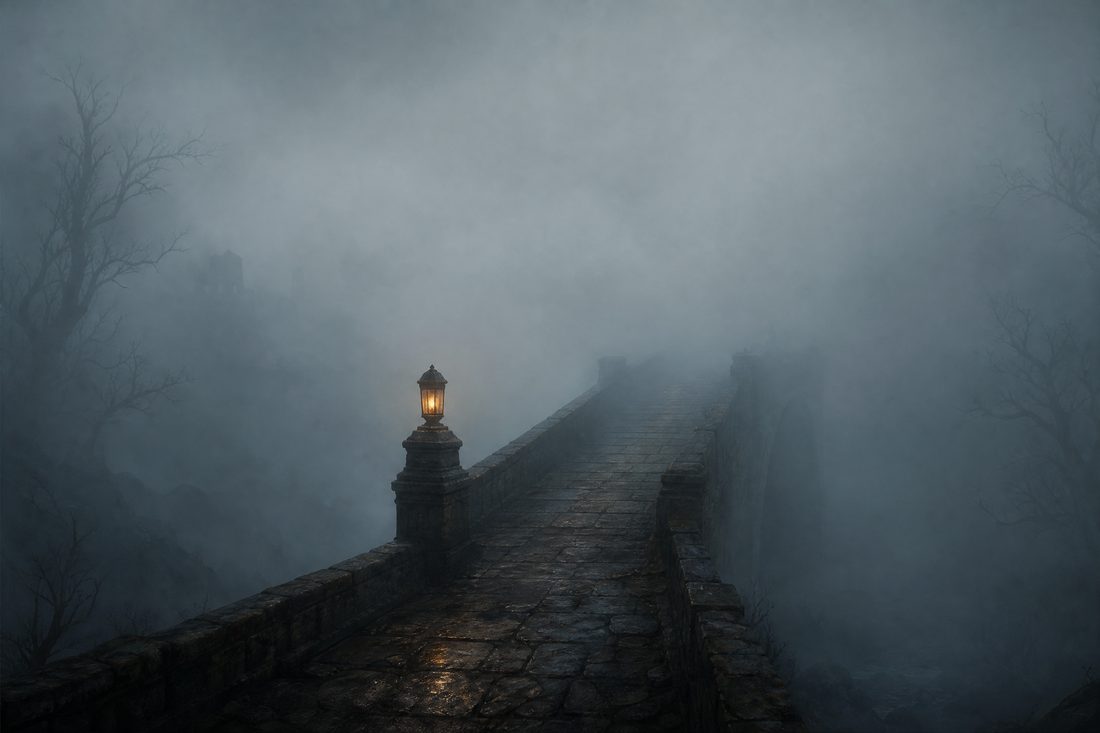
The fens are the best-realised place in any game we have logged this year. Reeds move in bands as wind crosses them, standing water reflects a sky that is doing something specific rather than something atmospheric, and the fog is genuinely volumetric — it pools in low ground, thins over water, and has depth you can judge by watching a lamp go from a disc to a glow to nothing.
It took us about four hours to notice that none of it was affecting anybody but us.
The measurement
The test is straightforward and anybody can repeat it. Pick a static guard on open ground, approach along the same line in different conditions, and record the distance at which the detection indicator first moves. Ten approaches per condition, same guard, same route, same posture.
| Condition | Visibility (player) | Detection distance |
|---|---|---|
| Clear, midday | Unlimited | 22.1 m |
| Light haze | ~40 m | 22.0 m |
| Heavy fog | ~12 m | 21.9 m |
| Whiteout | ~6 m | 22.1 m |
| Night, clear | ~25 m | 16.4 m |
Darkness is modelled. Fog is not. The game has the machinery to make weather matter — the night figure proves it — and simply never connected the fog volume to the perception system.
Why this is worse than doing nothing
A game with no weather at all is neutral. A game with fog that blinds only the player has quietly added a difficulty modifier that arrives on a nine-minute timer, cannot be predicted, cannot be turned off, and is never explained.
We felt it before we understood it. There were missions that seemed unfairly hard and, checked against our log afterwards, every one of them had been attempted in heavy fog. The player is told, visually and very convincingly, that they are concealed. They are not.
Asymmetric weather does not add tension, it adds noise. The player cannot learn a rule that only applies to them and is never stated.
The nine-minute cycle
Too fast to plan around and too slow to ignore. Conditions snap rather than build: we recorded twenty transitions and in fourteen of them the fog density changed to its new value within about two seconds, with no intermediate state.
The consequence is that waiting out bad weather is the optimal play, which is the most boring possible interaction with a sky. In a game whose fog is this good to look at, being incentivised to sit in a corner until it passes is close to tragic.
The game around it
Genuinely good, which is why this scores as well as it does. The levels are open in a way that rewards patience, the guard routines have enough irregularity to stay interesting without becoming unlearnable, and the tools are few and well differentiated. There is a mid-game mission in a flooded mill that is among the best stealth level design we have played.
The writing is thin and the story does not survive its own ending, but neither matters much in a game where the pleasure is in the route you took across a field.
What a fix would look like
Two numbers. Multiply guard detection range by a factor derived from local fog density, and give the player a visible indicator that the factor is active. Both are small changes to an existing system, and the night behaviour shows both are already possible in this engine.
| Element | Assessment |
|---|---|
| Fog rendering | Excellent, volumetric, believable |
| Fog effect on detection | None measurable |
| Darkness effect on detection | Present and well tuned |
| Transitions | Snap between states in most cases |
| Level design | Strong throughout |
Where this leaves it
A good stealth game carrying a weather system that works against its own player. The recommendation stands, with one piece of practical advice that should not be necessary: treat the fog as decoration, because that is what it is, and plan your approach as though the air were clear.