
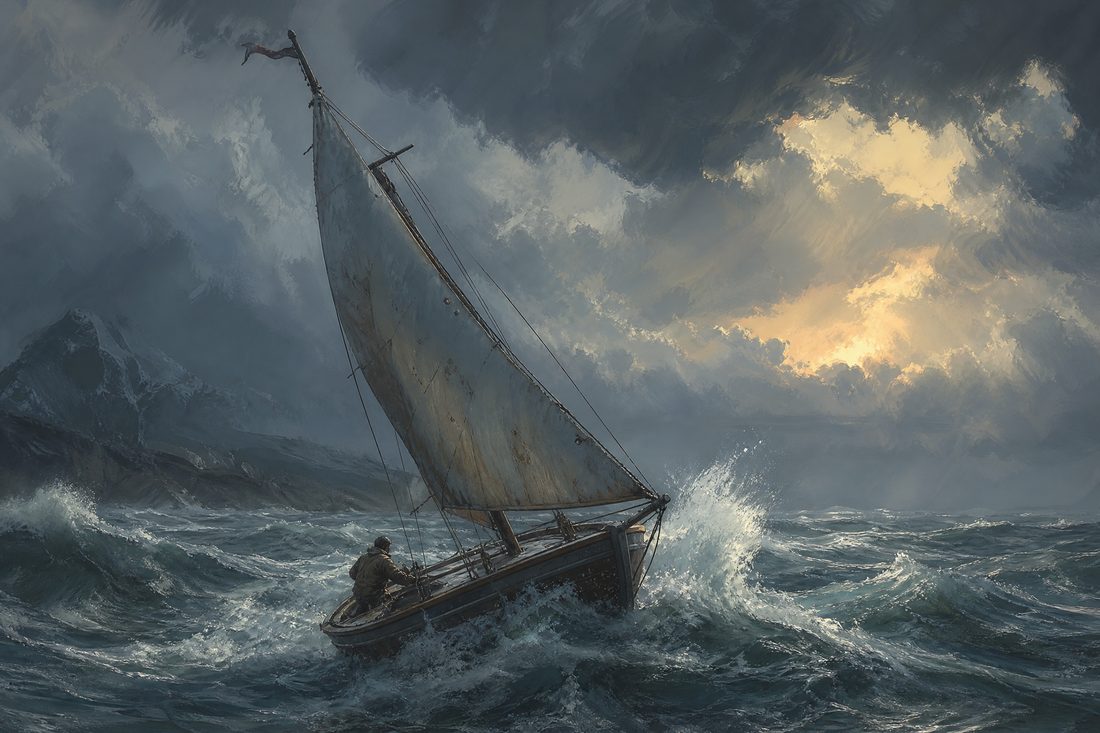
You sail a small single-masted boat between islands, carrying cargo that has deadlines and a hull that has limits. There is no combat, no upgrade tree worth the name, and about nine hours of learning before the game becomes what it actually is.
What it becomes is the only game we have played where we could look at the sky and be right.
The case for slowness
Almost every weather system runs on a cycle between eight and twenty minutes, because a designer wants a player to see variety in a session. The cost is that no condition lasts long enough to be worth acting on. If a squall will pass in six minutes, the correct response is always to wait, and the sky becomes scenery with a timer.
At fifty-one minutes, waiting costs a delivery. You have to decide, and to decide you have to read what is coming, and that turns the entire horizon into information.
| System | Cycle length | Can be forecast |
|---|---|---|
| Leeward | 51 min | Yes, reliably |
| Moorlight | 22 min | Yes, with practice |
| White Season | 18 min | Partly |
| Harrowfield | 14 min | No |
| Fenwatch | 9 min | No |
What you learn to read
Four signs, none of them on an interface. The colour of the horizon to windward about twenty minutes ahead of a change. The behaviour of the swell, which builds before the wind arrives rather than with it. The height of the cloud base. And the birds, which leave open water well ahead of a real blow and are the single most reliable indicator in the game.
We were reading three of the four by hour twelve and the swell properly by hour thirty. That progression is the game's actual difficulty curve, and nothing tells you it exists.
A forecast the player makes with their eyes is worth more than any forecast a game prints on a panel. The panel makes weather a fact; the eyes make it a judgement.
Symmetry
Verified as thoroughly as we could manage. Other vessels respond to the same conditions: they shorten sail before a blow, they run for harbour, and if you follow one that has read the sky better than you have, you will end up somewhere sensible. We tested this deliberately across six deteriorations and the traffic behaved consistently every time.
Harbours also close in a strong onshore wind, which is symmetrical in the least convenient possible way and is the correct decision.
Where it costs the player
Those first nine hours are genuinely bad. Before you can read anything, the weather is simply an unexplained force that ruins deliveries, and the game offers almost no help. We would have stopped playing at hour four if this were not a review, and we suspect most players do.
The interface is also unnecessarily hostile: cargo contracts are buried three menus deep, the map does not indicate which harbours are exposed to which wind directions, and the boat's condition is communicated through sound alone in a way that is atmospheric and impractical.
The trade it makes
A fifty-one minute cycle means a two-hour session might contain two weather states. If you play in half-hour bursts you may sail in the same conditions for a week of real time, and the variety this system provides is invisible at that scale.
That is a real cost and it is why this scores an 8.0 rather than higher. The decision is right for the game it wants to be and wrong for a substantial share of the people who will buy it, and the game never acknowledges the tension.
| Element | Assessment |
|---|---|
| Cycle length | Slowest logged; enables forecasting |
| Environmental indicators | Four, all off-interface, all reliable |
| Symmetry with traffic and harbours | Verified across six deteriorations |
| First nine hours | Opaque and discouraging |
| Interface | Actively unhelpful |
Where this leaves it
The strongest argument available for slow weather, and a reminder that the argument has a price. What this game proves is that forecasting is the most rewarding thing a sky can offer a player, and that no system running on a ten-minute clock can ever offer it.